Table Of Contents:
1. You keep asking: “Should we model this?”
2. You expect early-stage models to deliver late-stage answers
3. You believe more model detail always leads to better decisions
4. You treat the model as the solution instead of the workflow
5. You discover data requirements halfway through the project
6. You are trying to eliminate uncertainty instead of managing it
Conclusion
In pharmaceutical process development, the question is rarely whether you should use modeling.
The real question is: what decision are you trying to make, and what is the most appropriate workflow to support that decision?
Too often, teams adopt a single view of modeling and apply it across every stage of development. The result is predictable. Early-stage programs become overburdened by unnecessary complexity, while later-stage programs struggle to answer questions that require greater rigor and process understanding.
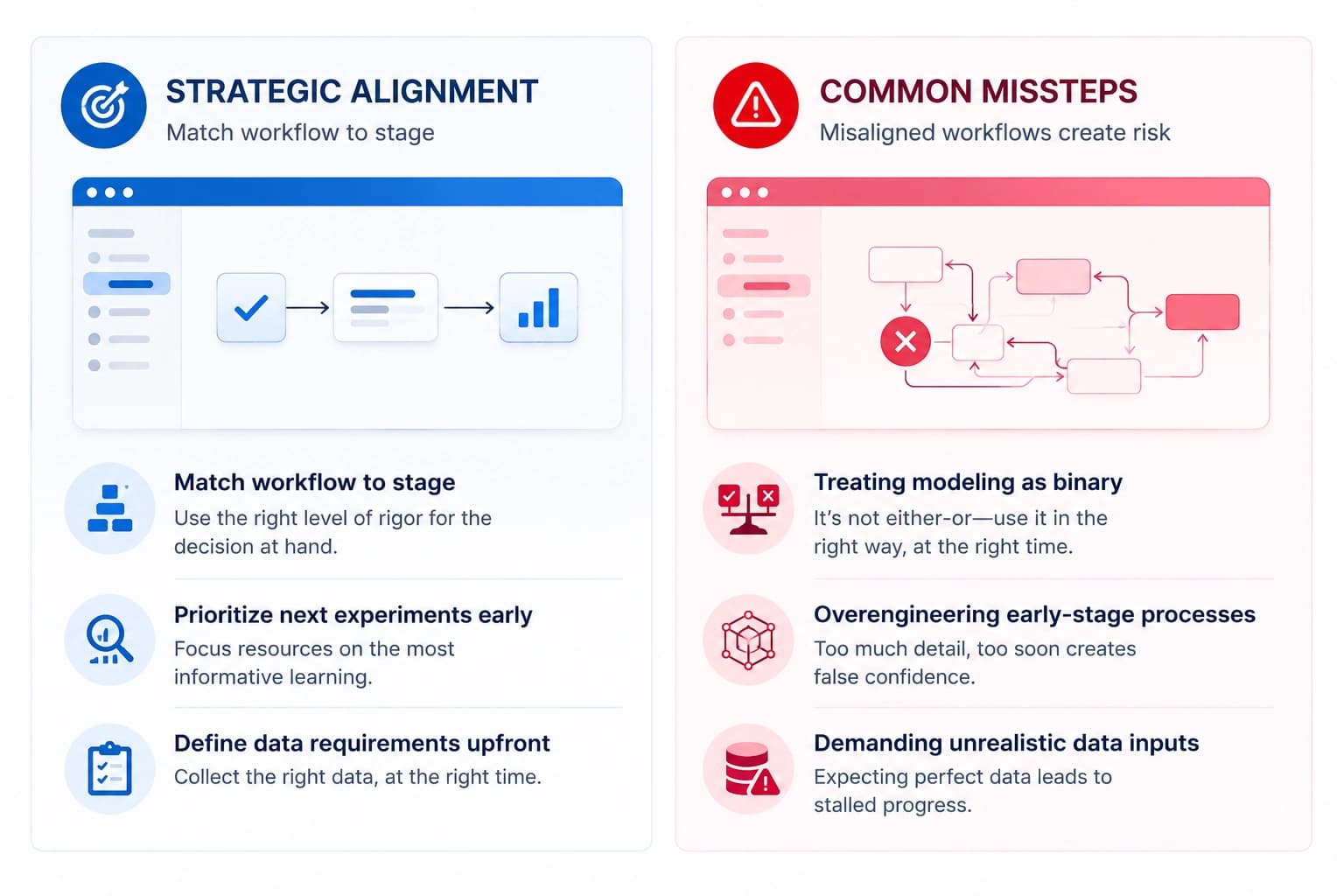
The most successful organizations recognize that modeling workflows should evolve alongside the program. The right workflow is determined not by the sophistication of the model itself, but by the decision being made, the available data, and the level of uncertainty the team needs to manage.
If any of the following sound familiar, your team may be using the wrong workflow.
1. You keep asking: “Should we model this?”
This is often the first sign of a deeper problem.
Modeling is not a binary choice. It is not something a team either does or does not do. Different stages of development require different types of models and different levels of detail.
A more useful question is:
What decision are we trying to make?
If the goal is to determine which experiments to run next, the workflow should focus on learning and uncertainty reduction. If the goal is to support scale-up, optimization, or technology transfer, the workflow needs to provide a higher level of fidelity and evidence.
The decision should drive the workflow—not the other way around.
2. You expect early-stage models to deliver late-stage answers
Many teams expect a model built with limited data to provide highly accurate predictions across a wide operating space.
That expectation is unrealistic.
Early-stage development is characterized by limited material, sparse data, and evolving process understanding. At this stage, the role of modeling is not to provide manufacturing-grade predictions. Its role is to help teams learn faster.
A good early-stage workflow should:
Reduce uncertainty
Prioritize the most informative experiments
Identify promising operating regions
Highlight key process sensitivities
The objective is guidance, not perfection.
3. You believe more model detail always leads to better decisions
One of the most common misconceptions in modeling is that more complexity automatically produces better outcomes.
In reality, model fidelity should match both the available data and the decision being supported.
Adding more equations, parameters, or mechanistic detail does not necessarily improve decision quality. In many cases, it simply introduces additional assumptions that cannot be adequately supported by experimental evidence.
The best model is rarely the most complex one.
It is the simplest model capable of answering the question at hand with sufficient confidence.
4. You treat the model as the solution instead of the workflow
A model is only one component of a broader decision-making process.
Successful modeling programs integrate:
Problem definition
Experimental design
Data preparation
Calibration and validation
Simulation and analysis
Decision support
When these activities are disconnected, modeling often feels slow, fragile, and difficult to trust.
When they are connected within a coherent workflow, modeling becomes operational. It becomes a practical tool for accelerating development rather than an isolated technical exercise.
5. You discover data requirements halfway through the project
Few things derail a modeling effort faster than discovering that the necessary data was never collected.
Unfortunately, this happens frequently.
Teams begin a project with ambitious goals only to realize later that key experiments were not performed, critical metadata was not captured, or the available datasets are insufficient for the intended analysis.
A robust workflow makes expectations explicit from the beginning.
Before work starts, teams should understand:
What data is required
Which experiments are essential
Which data is optional
What level of confidence can realistically be achieved
6. You are trying to eliminate uncertainty instead of managing it
This may be the most important misconception of all.
The purpose of process modeling is not to eliminate uncertainty.
The purpose of process modeling is to make better decisions despite uncertainty.
Every process model is a simplification of reality. Every dataset is incomplete. Every development program operates under constraints.
The goal is not perfect prediction.
The goal is to reduce uncertainty enough to make the next decision with confidence.
Organizations that understand this tend to extract significantly more value from modeling because they use it as a decision-support tool rather than a search for absolute truth.
Conclusion
The most effective process development organizations are not the ones using the most sophisticated model at every stage.
They are the ones applying the right workflow at the right time.
Early-stage programs need workflows that accelerate learning and reduce uncertainty with limited material and sparse data.
Late-stage programs need workflows that provide the rigor, detail, and confidence required for optimization, scale-up, and technology transfer.
Both are valuable.
Both serve different purposes.
And both ultimately support the same objective: making better decisions under uncertainty.
