
Table Of Contents:
Why Manual Transformation Stops Scaling
What a Governed Data Pipeline Changes
What This Looks Like in ModelFlow™
Using AI to Build Pipelines Faster
From Raw Readings to Defensible Results
How governed data transformations turn fragmented CMC data into reproducible, model-ready datasets.
Every process model begins with a data transformation.
Before a mechanistic model can be calibrated, before a machine learning algorithm can be trained, and before a digital twin can simulate a process, raw experimental data must first be transformed into something those models can actually understand. Instrument outputs need to be cleaned, units converted, variables derived, datasets combined and metadata aligned. Yet despite being fundamental to every computational workflow, this step is still treated as an informal activity in many CMC organisations.
When people think about computational modelling, they naturally focus on the model itself. They think about mechanistic equations, machine learning algorithms or simulation software. In reality, every model depends on another workflow that receives far less attention: the sequence of transformations that converts raw experimental measurements into model-ready data.
This workflow is just as important as the model itself. Every decision made during data preparation, how measurements are converted, how variables are derived, how missing values are handled, how datasets are combined, directly influences the quality and reproducibility of everything that follows. If two scientists prepare the same dataset differently, they are effectively building two different models before the first equation has even been solved.
Data preparation is therefore not simply a preprocessing task. It is part of the scientific model lifecycle.
Why Manual Transformation Stops Scaling
Manual data preparation rarely fails overnight. It simply becomes harder to manage as organisations generate more data and involve more people.
The same transformation is recreated by different scientists in slightly different ways. Instrument software changes, export formats evolve and spreadsheets gradually accumulate years of formulas that only one or two people fully understand. New projects often begin by copying an existing workbook, modifying a few formulas and hoping nothing important breaks.
The cost isn't only the hours scientists spend preparing data.
The larger cost is inconsistency.
Transformation logic becomes scattered across personal spreadsheets, vendor applications and scripts. Changes become difficult to track. Different teams unknowingly apply different versions of the same calculation. Eventually, when someone asks how a value in a report was derived from the original instrument output, the answer may exist—but it is buried three tabs deep in somebody else's spreadsheet rather than captured as part of a transparent scientific workflow.
What a Governed Data Pipeline Changes
A governed data pipeline approaches data preparation differently.
Instead of repeating the same manual transformations every time new data arrives, the transformation logic is defined once as a reusable workflow. Every subsequent dataset follows exactly the same process, producing consistent outputs regardless of who generated the data or when it was processed.
The immediate benefit is consistency. Raw instrument data is transformed into standardised, model-ready datasets using the same logic every time, reducing variability introduced by manual preparation.
Finally, pipelines make computational science scalable. Instead of rebuilding the same spreadsheet logic for every project, teams create reusable workflows that can process growing volumes of experimental data while maintaining consistency across laboratories, projects and development programmes.
These three outcomes — consistency, traceability and scalability — are what ultimately make computational models more trustworthy.
What This Looks Like in ModelFlow™
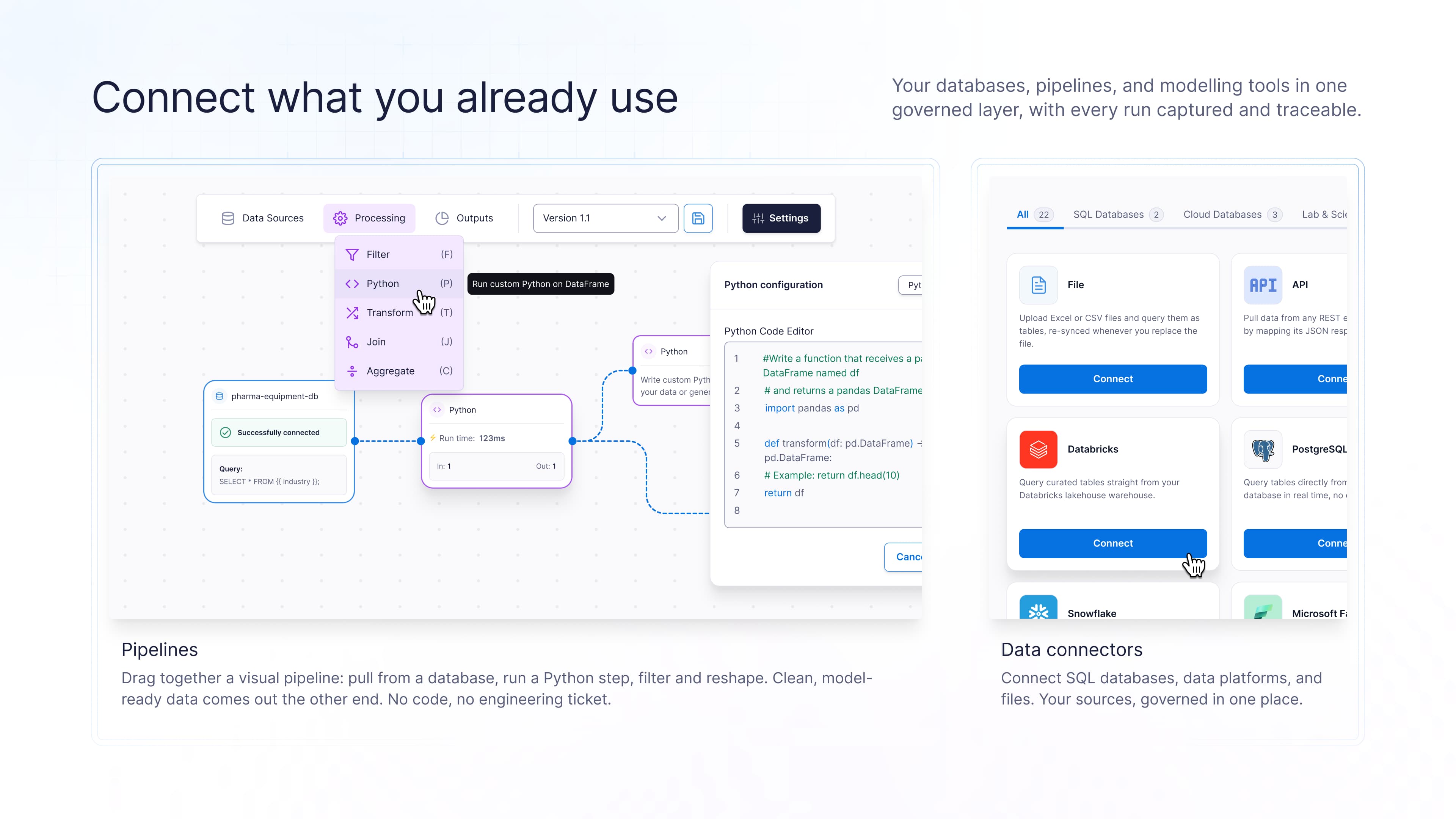
ModelFlow™ implements this approach through visual data pipelines that transform raw experimental data into clean, standardised, model-ready datasets.
Scientists can upload raw instrument outputs directly, while the pipeline automatically performs the required transformations, validates incoming data against expected schemas and standardises outputs for downstream workflows. Pipelines can combine information from multiple sources, create derived variables where required and produce datasets that are immediately ready for modelling without relying on manual spreadsheet manipulation.
Because the transformation logic lives inside the pipeline rather than individual workbooks or applications, it becomes visible, reusable and version controlled. Changes can be made once and automatically propagate wherever that workflow is used, providing a single, governed source of truth for data preparation across projects.
Using AI to Build Pipelines Faster
Creating robust data pipelines traditionally required configuring every transformation step manually. ModelFlow™ simplifies this process through an AI-assisted pipeline builder that helps scientists generate transformation workflows using natural language.
Rather than constructing every node individually, scientists describe the outcome they want and the assistant proposes the required transformation steps, asking for clarification whenever additional information is needed. The resulting pipeline remains fully editable, with scientists reviewing, refining and approving the workflow before it is used.
AI accelerates pipeline creation. It does not replace scientific judgement.
From Raw Readings to Defensible Results
As computational science becomes increasingly embedded within pharmaceutical development, organisations need to think beyond the models themselves. Confidence in a prediction begins long before a simulation is run or an algorithm is trained. It begins with the process that prepares the data feeding those models.
Governed data pipelines transform what has traditionally been an informal collection of manual tasks into a transparent, repeatable and reproducible scientific workflow. Scientists spend less time preparing data and more time generating insight, while organisations gain confidence that every model is built on data that is consistent, traceable and defensible.
Reliable computational models do not begin with better algorithms.
They begin with better data workflows.
