Table Of Contents:
Introduction
The Challenge: Why Traditional Drying Development Falls Short
How Mechanistic Modeling De-Risks Process Development
Case Study: Scaling Up a High-Risk Drying Process
Conclusion
References
Introduction
The final physical properties of an Active Pharmaceutical Ingredient (API) are often determined in the last manufacturing step: drying. This critical unit operation does more than simply remove solvents; it defines the API’s bulk powder properties and physical characteristics, including its crystal habit, particle size, and surface area. These attributes directly govern the performance of the final drug product, affecting everything from powder flow and blend uniformity to dissolution profiles and bioavailability [1], [2]. For manufacturers, ensuring this final step is controlled, robust, and repeatable is fundamental to delivering a safe and effective medicine.
The Challenge: Why Traditional Drying Development Falls Short
While drying appears to be a simple operation, it is governed by complex, non-linear phenomena. Mechanisms such as particle breakage, agglomeration, moisture diffusion, and heat and mass transfer collectively determine the final product quality. As a result, process development is not always trivial. Input material properties, operating conditions, and equipment all play a role in achieving consistent performance.
This complexity exposes the limitations of traditional development methods.
Limits of DoE: DoE works well to identify factors and interactions in a bounded design space, but drying often shifts in non-linear ways that break those local assumptions. The outcome is models that look good in the lab yet overfit, struggle to scale, and miss the true drivers [3].
Inefficient Experimentation: This leads to resource-intensive lab-scale campaigns that can yield a process that is functional, but not truly optimized, often resulting in uncontrolled particle size distributions and longer than needed cycle times [4].
Fragile Scale-Up: A process that works perfectly in a 50 mL lab dryer often fails unpredictably in a 1000 L production vessel. This fragility demands yet another round of experiments to bridge the gap between scales [5], [6].
Ultimately, this experiment-heavy approach is slow, expensive, and carries significant risk, especially late in development when unexpected behavior can delay timelines.
How Mechanistic Modeling De-Risks Process Development
A mechanistic modeling approach offers a direct solution to these challenges by shifting the focus from empirical data-fitting to leveraging a deep understanding of fundamental physics. Instead of connecting experimental data points, a mechanistic model is built on the principles of energy, mass, and particle population balances to define the "why" behind process behavior.
This first-principles approach transforms the development workflow:
Reduced Experimental Burden: Key material properties, like solvent-solid interactions, are determined once through a minimal set of characterization experiments. These properties can then be applied to virtual models of different equipment, allowing for direct comparisons without running parallel experimental programs.
Virtual Process Exploration: Once calibrated, the model enables thousands of in-silico "what-if" scenarios, allowing teams to explore the entire operating envelope and quantify the impact of process parameters without real-world experiments.
Data-Driven Process Understanding: Global sensitivity analysis can be used to rank process parameters by their impact, focusing experimental work only on the variables that are truly critical to quality.
Reliable Scale-Up: By accounting for changes in vessel geometry, surface area, and agitation dynamics, the model acts as a translation tool for scale-up. This provides a rational, calculated starting point for the production-scale process, moving from a series of engineering batches to a single, successful verification run.
Case Study: Scaling Up a High-Risk Drying Process
The Challenge
A top 10 pharma company faced a problem: scaling up their drying process from a 1000-liter to a 3000-liter vessel. Initial attempts to build a purely data-driven model failed due to high experimental noise, leaving the team without a reliable path for scale-up.
Agitation was known to be a key driver of process variability, particularly for the percentage of fines, but its non-linear effects were impossible to capture with standard DoE models. A traditional, experiment-heavy approach was deemed too slow, too costly, and too high-risk.
The Solution
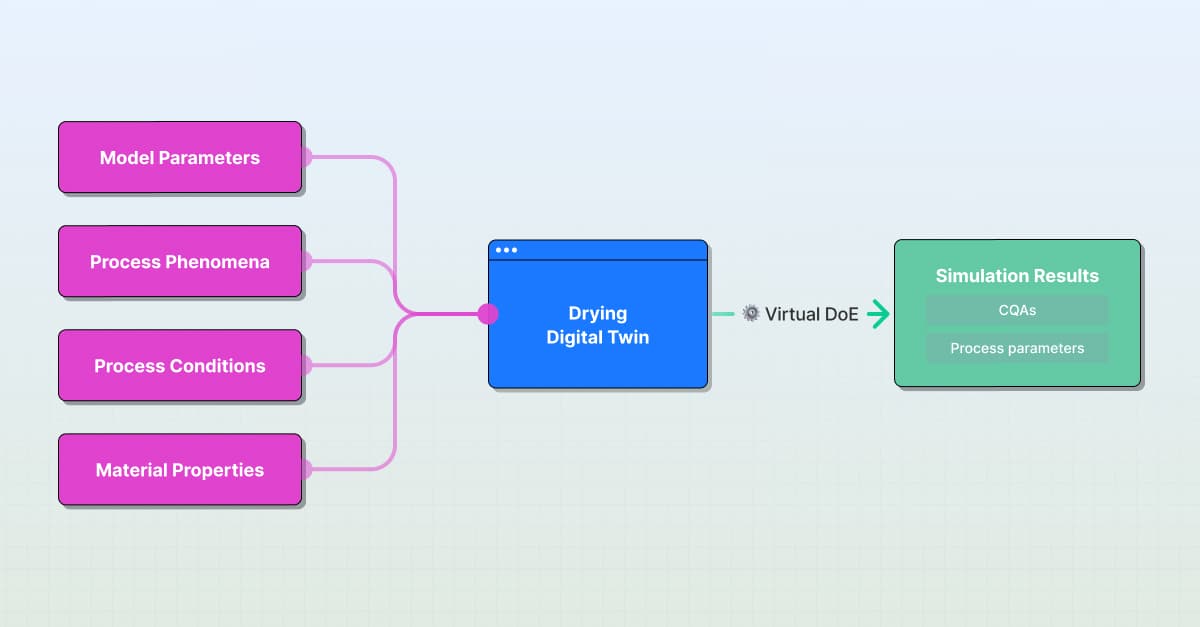
To overcome the risks and delays of a traditional experimental approach, a first-principles, mechanistic model was deployed. This model, packaged into a user-friendly application, served as a digital twin of the drying process, enabling rapid virtual experimentation.
Leveraging a Virtual DoE
The core of the solution was a Virtual DoE. Instead of conducting dozens of resource-intensive physical runs in the plant, the team simulated thousands of experiments through the app. This powerful approach allowed them to achieve several key objectives quickly:
Explore Process Sensitivities: The Virtual DoE systematically mapped how the input factors and process parameters influenced the CQAs. The team could visualise the non-linear impact of agitation speed on the final percentage of fines, a relationship that they were unable to accurately capture with physical experiments.
Define the Design Space: By simulating thousands of scenarios, the team rapidly defined a robust Design Space to meet quality targets. This provided a clear operational window for manufacturing, ensuring batch-to-batch consistency.
Optimize Operating Conditions: Within this validated Design Space, the model was used to identify the optimal agitation and temperature profiles that would minimize the percentage of fines and reduce the overall cycle time.
This methodology allowed the team to run experiments without running experiments, enabling them to de-risk the process, optimize operating conditions, and prepare for a fast, successful scale-up.
The Outcome
The final model delivered significant value, providing the confidence to accelerate the project and de-risk their drying process.
Predictive Accuracy: The model predicted CQAs with an absolute error within 10% across scales and Design Space.
Improved Robustness: The model and results gave the project team the justification to eliminate one entire production-scale robustness campaign, accelerating the project timeline by over 3 months and allowing the drug to get to market a full quarter earlier than planned.
Cost Savings: Over $2 million was saved in direct experimental costs, including the value of the API not consumed, freed-up plant time, and reduced analytical resources.
Conclusion
For pharma manufacturers, the adoption of mechanistic modeling represents a strategic shift from reactive, trial-and-error experimentation to proactive, predictive process development. By grounding development in the fundamental physics of a unit operation, companies can build deeper process understanding, reduce their reliance on costly physical experimentation, and accelerate the delivery of high-quality medicines to patients.
At Polymodels Hub, it’s our mission to help pharma companies harness the power of data and models in apps and workflows to accelerate drug development.
What if you could plug and play a workflow like this one? The drying workflow for scale-up is one of many workflows available in ModelFlow.
Book a demo to see how workflows can accelerate your R&D pipelines.
References
E. Kougoulos, C. E. Chadwick, and M. D. Ticehurst, ‘Impact of agitated drying on the powder properties of an active pharmaceutical ingredient’, Powder Technol., vol. 210, no. 3, pp. 308–314, July 2011, doi: 10.1016/j.powtec.2011.03.041.
A. Lekhal, K. P. Girard, M. A. Brown, S. Kiang, J. G. Khinast, and B. J. Glasser, ‘The effect of agitated drying on the morphology of l-threonine (needle-like) crystals’, Int. J. Pharm., vol. 270, no. 1, pp. 263–277, Feb. 2004, doi: 10.1016/j.ijpharm.2003.10.022.
ISPE, ‘In-Silico Data-Driven Mechanistic Model–Assisted Process Validation | Pharmaceutical Engineering’. Accessed: Dec. 05, 2025. [Online]. Available: https://ispe.org/pharmaceutical-engineering/may-june-2024/silico-data-driven-mechanistic-model-assisted-process
N. K. Nere, K. C. Allen, J. C. Marek, and S. V. Bordawekar, ‘Drying process optimization for an API solvate using heat transfer model of an agitated filter dryer’, J. Pharm. Sci., vol. 101, no. 10, pp. 3886–3895, Oct. 2012, doi: 10.1002/jps.23237.
N. Yazdanpanah, C. N. Cruz, and T. F. O’Connor, ‘Multiscale modeling of a tubular reactor for flow chemistry and continuous manufacturing’, Comput. Chem. Eng., vol. 129, p. 106510, Oct. 2019, doi: 10.1016/j.compchemeng.2019.06.035.
E. W. Conder et al., ‘The Pharmaceutical Drying Unit Operation: An Industry Perspective on Advancing the Science and Development Approach for Scale-Up and Technology Transfer’, Org. Process Res. Dev., vol. 21, no. 3, pp. 420–429, Mar. 2017, doi: 10.1021/acs.oprd.6b00406.
