Table Of Contents:
The Shift from Unit Models to System Models
Understanding Root Cause in a Connected Downstream Process
Conclusion: Act Earlier, Make Better Decisions, Accelerate Time-to-Market
Modern biologics development still suffers from a familiar bottleneck: downstream unit operations are optimized in isolation.
Teams routinely invest significant effort in optimizing individual steps - capture chromatography, viral inactivation, filtration - only to discover that improvements in one operation introduce new constraints elsewhere in the process.
This is the cost of siloed optimization. Teams end up solving the problem where it shows up, not where it actually starts.
That is why the next frontier in downstream process development is not simply better optimization of a single unit operation. It is system modeling.
With an End-to-End (E2E) digital twin in ModelFlow Downstream™, downstream purification can be modeled as a connected process rather than a series of isolated steps. The output of one operation becomes the input to the next. Variability is no longer trapped inside a local experiment. It can be followed across the process.
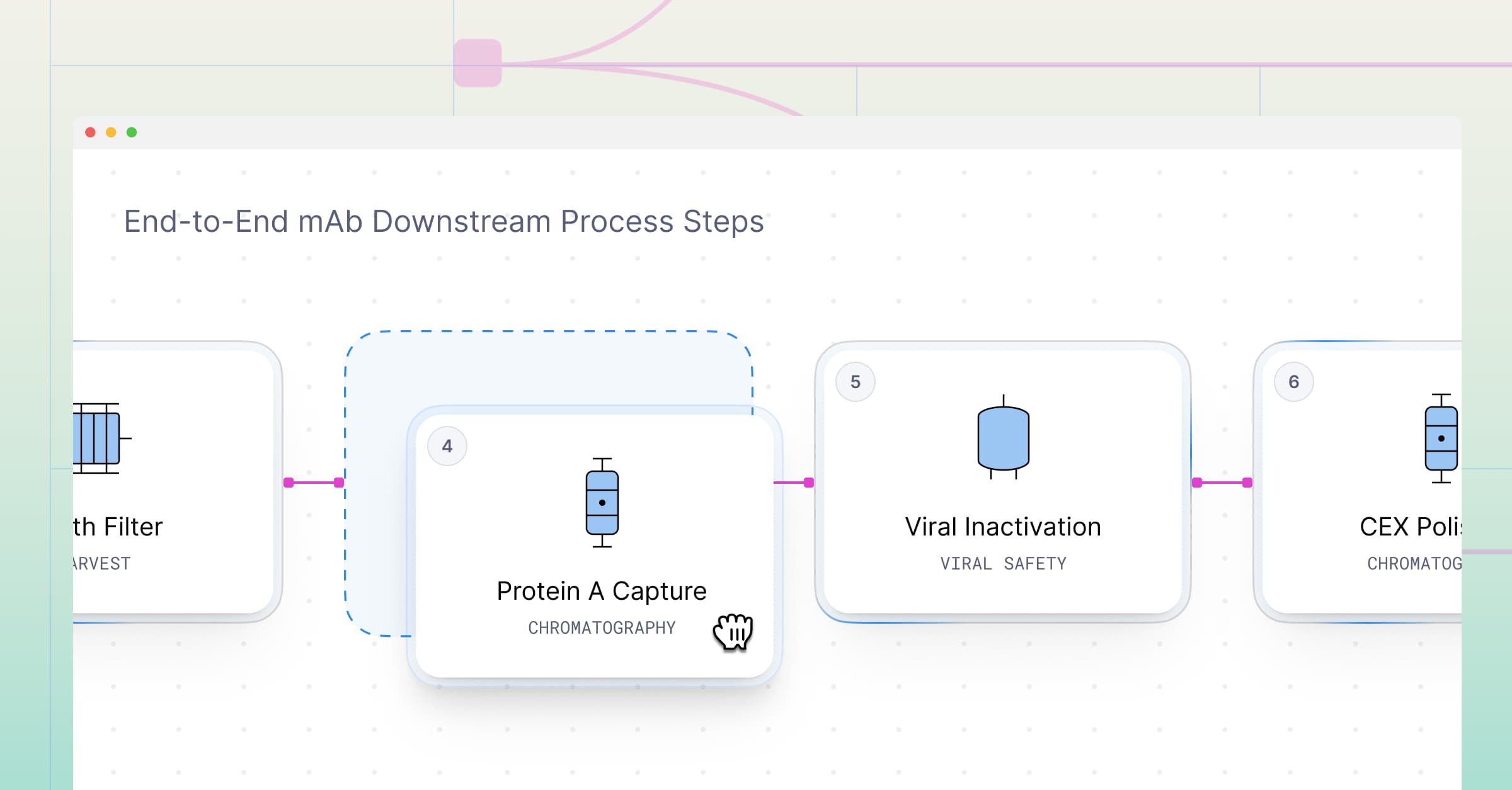
That shift matters because it changes the questions teams can answer. Instead of asking whether one step performs well on its own, they can ask how the entire downstream train responds when process conditions change.
The Shift from Unit Models to System Models
Traditional downstream development remains highly iterative. It depends heavily on physical experimentation, accumulated experience, and stepwise troubleshooting. That approach works, but it is slow, resource-intensive, and often blind to cross-unit effects.
ModelFlow Downstream™ is designed to address this challenge. It enables teams to develop and optimize processes step by step - tackling individual workflow problems such as Protein A chromatography yield and load optimization or the impact of ionic strength disturbances on CEX recovery - while simultaneously supporting fully connected downstream modeling workflows. These workflows start from a real process question, structure the relevant data, calibrate the appropriate mechanistic models, and use simulation to guide decisions. The goal is not to build models for their own sake, but to answer development questions with enough process context to make the results actionable.
At the core is a simple but powerful idea: downstream unit operations should not be treated as separate islands. They should be linked. The state leaving one step, including composition, concentration, and impurity profile, should define the starting point for the next. That is what allows process teams to see the true ripple effect of process decisions.
Understanding Root Cause in a Connected Downstream Process
Consider a team seeing elevated high-molecular-weight impurities in a cation exchange chromatography step.
In a conventional workflow, the response is immediate: optimize the CEX step. Adjust loading. Change the buffer. Rework the polishing DoE. Run another study to make the column handle the burden.
But the chromatography step may not be the real source of the problem.
In many cases, the issue begins earlier, during low-pH viral inactivation. Under acidic conditions, the molecule can partially unfold. During neutralization, those destabilized species can aggregate rapidly. By the time the material reaches cation exchange chromatography, the impurity burden is already built into the feed stream. The polishing step is not creating the problem. It is inheriting it.
This is exactly where End-to-End modeling becomes more valuable than isolated unit optimization.
Instead of treating CEX as a standalone polishing challenge, ModelFlow Downstream™ tracks how conditions in viral inactivation shape the material entering the next operation. Process teams can then see the true origin of the impurity burden and evaluate the downstream sequence as one connected system. Rather than over-optimizing the symptom, they can focus on the cause.
That leads to a very different development strategy. It reduces disconnected study loops, avoids false local optima, and gives teams a clearer view of where process risk is really coming from.
Conclusion: Act Earlier, Make Better Decisions, Accelerate Time-to-Market
The shift from siloed unit operations to system-wide End-to-End modeling is a practical necessity for modern biomanufacturing. By implementing a connected digital twin with ModelFlow Downstream™, CMC teams are empowered to:
Predict Cascading Impacts: Map the hidden ripple effects of every parameter change before a single drop of product hits the plant floor.
Identify the Global Design Space: Break free from artificial constraints and prove exactly where it is safe to operate across your entire downstream process.
Accelerate Time-to-Market: Replace iterative, blind physical experimentation with targeted, system-wide in-silico learning.
That is the real opportunity in downstream modeling.
Do not just optimize the step where the problem appears. Model the system that creates it.
