Table Of Contents:
Inside ModelFlow™ Downstream
Across the CMC lifecycle
Case study: De-risking cation exchange chromatography wash steps
Conclusion
References
What can ModelFlow™ do in minutes that takes weeks of wet-lab iterations?
What are the core problems with the current ways of working?
Material: Drug substance is scarce in early development, yet resin screening, load studies, and lifetime assessments routinely consume grams of it to nail down what are, in the end, a handful of model parameters. Small-scale high-throughput screening recovers some of that ground, but only some [2].
Sequential experimentation: A DoE campaign is retrospective by design: each round depends on the last, and the insight only arrives once the run is finished. Where the underlying behaviour is strongly coupled and non-linear, as it is across most of downstream (salt-dependent binding in ion exchange, the pH/time/temperature interplay of low-pH viral inactivation, the flux–TMP–fouling relationship in UF/DF), mapping the design space by experiment alone is rarely within budget.
Knowledge transfer: What a team learns in development rarely travels cleanly between scientists, sites, and project phases. Understanding that lives in slide decks and lab notebooks sits poorly against submissions that increasingly expect a mechanistic justification of the design space and control strategy [3].
Inside ModelFlow™ Downstream
ModelFlow™ Downstream is the biologics DSP package within PolyModels Hub's ModelFlow™ platform. It bundles curated workflows across three unit-operation families.
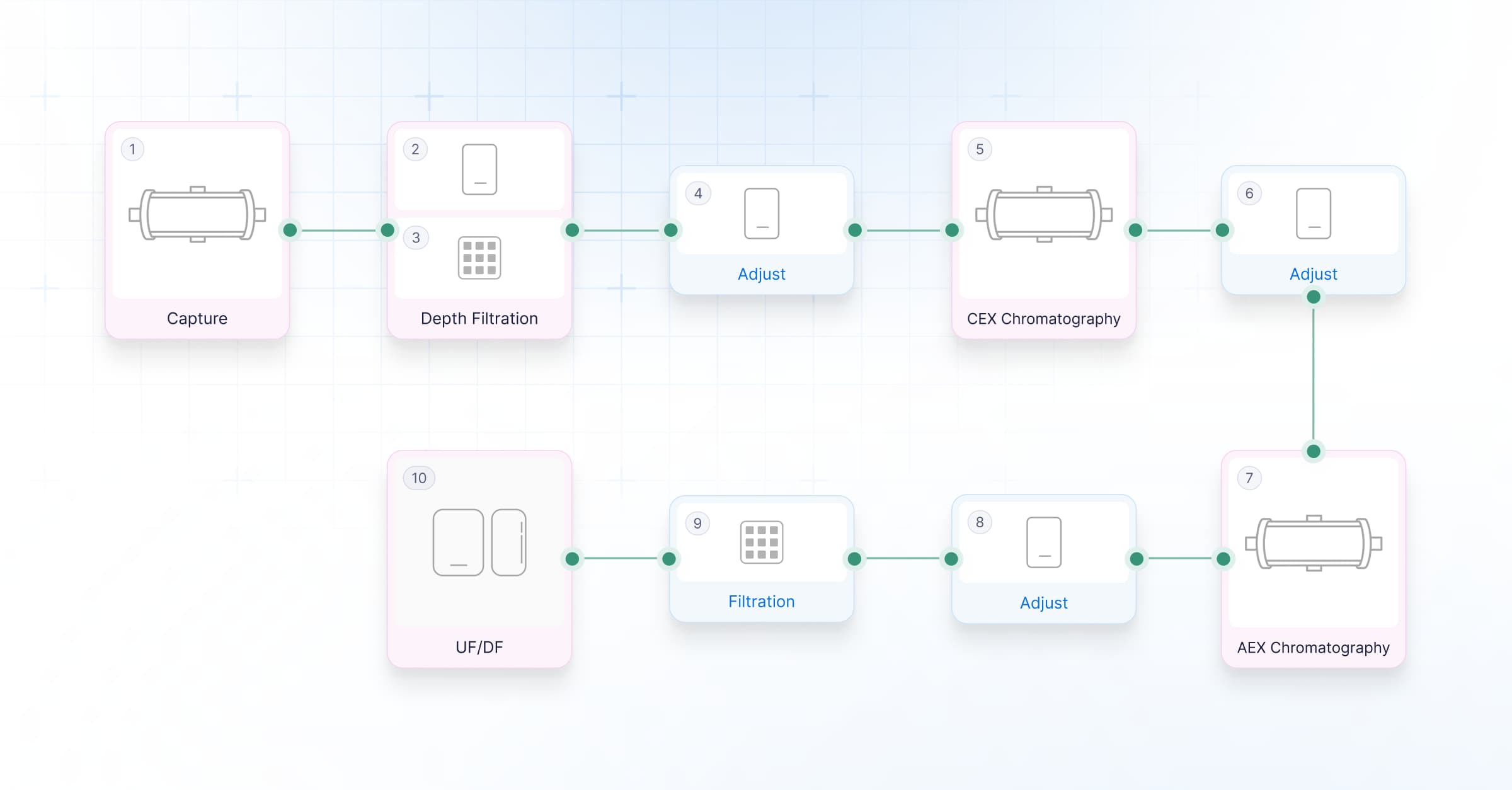
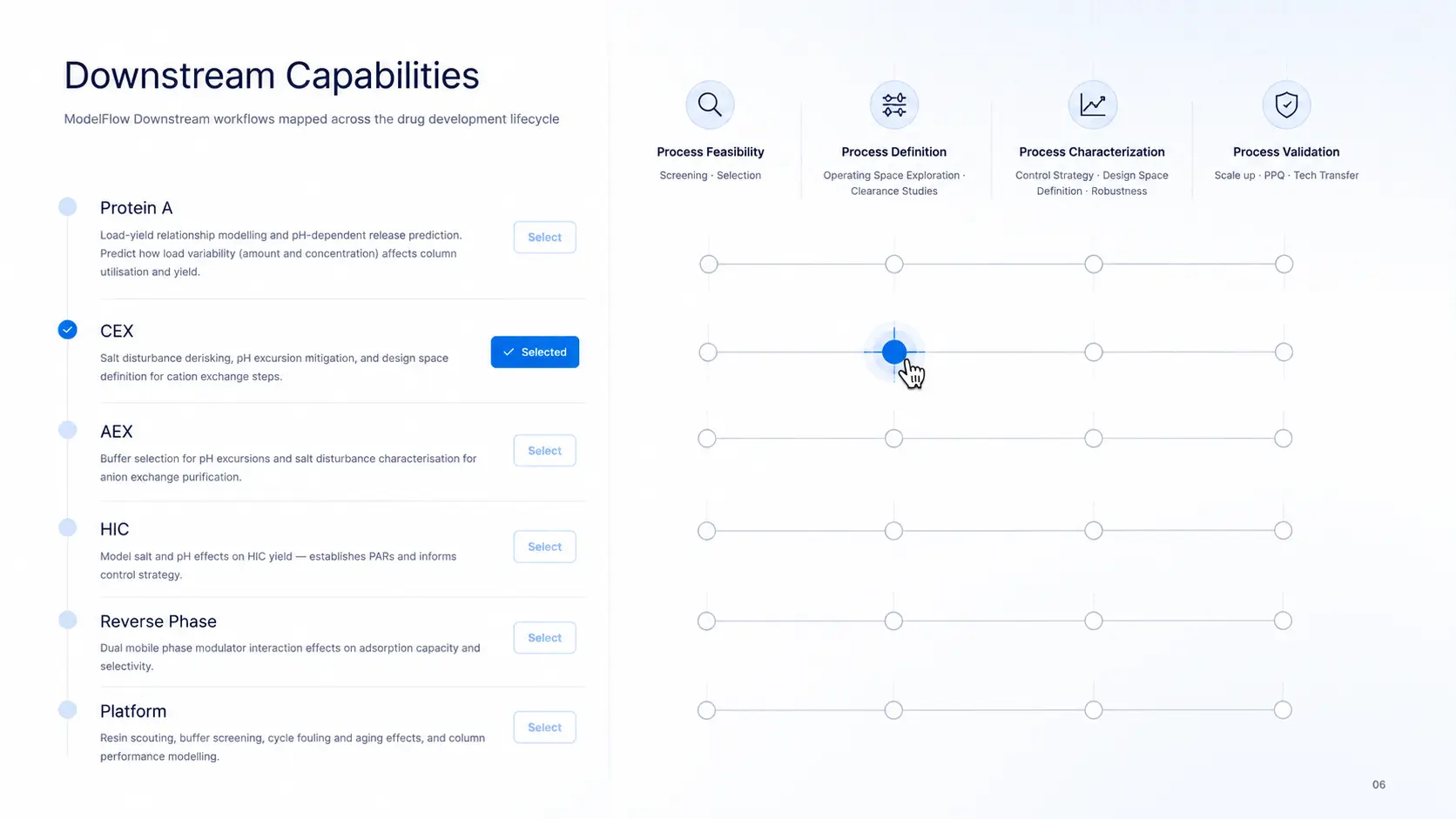
Chromatography: An expanding library of workflows across six modes (Protein A, cation and anion exchange, HIC, reverse phase, and platform steps), run on mechanistic transport models with a supporting library of isotherms, so you can map elution and yield, set proven acceptable ranges, and catch the failure modes that are expensive to provoke on real resin. A cation-exchange salt excursion that quietly costs yield shows up in the model in minutes. The same framework extends to Protein A load variability, buffer selection, and resin fouling and ageing, and feeds directly into design-space and control-strategy definition.
Viral inactivation: De-risk the low-pH hold without over-processing the product. Batch models couple inactivation kinetics with an aggregation submodel, so you can find the pH, hold-time, and a temperature window that achieves the required clearance and still protects yield. View insights through LRV heatmaps across the operating space, aggregation-risk surfaces, and operating windows that balance viral safety against yield, all ICH Q5A(R2)-ready [4]. Set safe operating ranges from the model rather than probing the edge of failure on real material.
TFF (UF/DF): Predict membrane performance at scale before you commit to a scale-up run. Tangential-flow models couple crossflow, TMP, and concentration with fouling kinetics, so you can navigate the fouling-versus-throughput trade-off, screen membranes and conditions from low-volume experiments, and see how the process behaves at scale. Quantify scale-up cost, the crossflow headroom you lose between scales, and flag whether an operating point stays inside the safe pressure window, so a scale-up problem shows up on screen and not on the floor.
Each workflow runs through a guided interface that needs no coding, over a Python backend that teams can read, extend, or customise. The platform also handles the surrounding work (data ingestion, versioning, traceability, and exportable outputs) that makes a modelling result defensible in a regulatory file [5].
Across the CMC lifecycle
Case study: De-risking cation exchange chromatography wash steps
Identifying a batch-critical deviation before it reaches the lab.
The problem. Wash steps in cation exchange are more sensitive than they appear. A leaking pump seal, an off-specification buffer, or a pocket of high-conductivity liquid that has not fully mixed can raise the salt level mid-wash and begin to displace product from the resin before elution. The resulting recovery loss is easily missed and difficult to attribute, because the disturbance is transient and rarely captured by routine in-process monitoring. Characterising it experimentally means deliberately introducing deviations on real columns. That is a multi-day campaign that consumes scarce drug substance, and it targets precisely the conditions a team is least willing to provoke: the point at which the process fails.
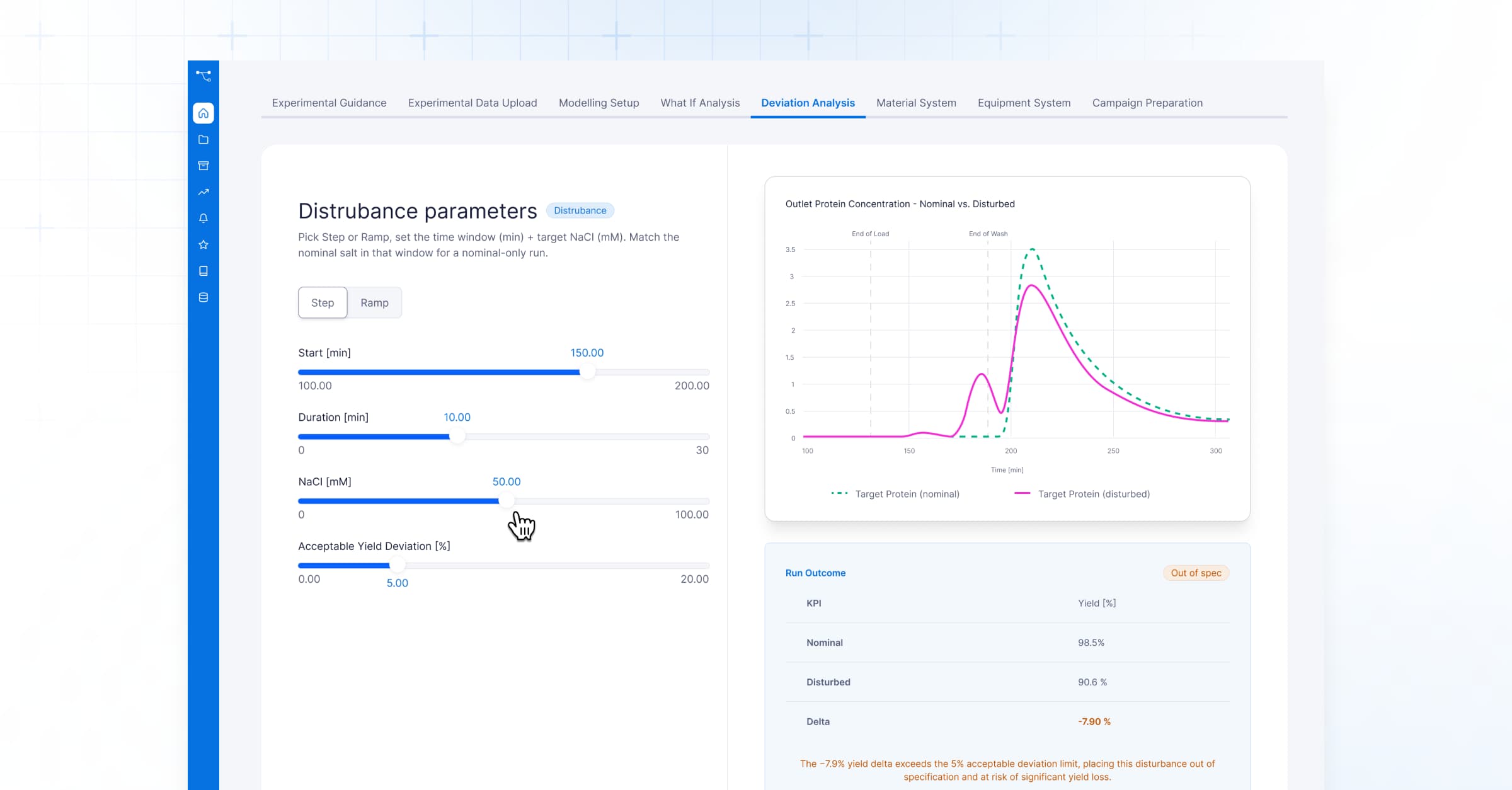
What ModelFlow™ Downstream did. Rather than take this to the bench, the team assessed it in silico. Working from a model already calibrated on the standard characterisation runs, ModelFlow™ Downstream simulated a realistic deviation, a 20-minute salt excursion to 65 mM during the wash, and compared it directly against the nominal process.
The result. The nominal process delivered 98.5% yield. Under the disturbance, that fell to 90.6%, a loss of 7.9 percentage points, enough to take a batch below a 95% recovery specification and into failure. Alongside the yield, ModelFlow™'s simulated elution profiles showed the cause: product coming off early and broad as the excursion displaced it from the resin mid-wash. Within half an hour, and before the process had even reached characterisation, the team had a quantified impact, a clear cause, and a defensible limit on wash ionic strength: edge-of-failure insight that would otherwise take a multi-day experimental campaign.
Conclusion
For biologics CMC teams, mechanistic modelling moves downstream development from experiment-heavy and reactive toward model-informed and predictive. Grounding decisions in the physics of chromatography, viral inactivation, and UF/DF lets a team characterise design spaces with less material, surface scale-up problems before they become expensive, and document process understanding in the form regulators increasingly ask for.
ModelFlow™ Downstream packages this as a growing library of validated workflows, behind a no-code interface and on a transparent, extensible Python backend.
PolyModels Hub builds workflows that help pharma teams put their data and models to work in drug development. If you'd like to see how ModelFlow™ Downstream fits your pipeline, book a demo with us today.
References
[2] F. Steinebach, T. Müller-Späth, and M. Morbidelli, 'Continuous counter-current chromatography for capture and polishing steps in biopharmaceutical production', Biotechnol. J., vol. 11, no. 9, pp. 1126–1141, Sept. 2016, doi: 10.1002/biot.201500354.
[3] T. Hahn et al., 'Mechanistic modeling, simulation, and optimization of mixed-mode chromatography for an antibody polishing step', Biotechnol. Prog., vol. 39, no. 2, e3316, Mar. 2023, doi: 10.1002/btpr.3316.
[4] ICH, 'ICH Q5A(R2) Viral Safety Evaluation of Biotechnology Products Derived from Cell Lines of Human or Animal Origin', International Council for Harmonisation, Sept. 2023.
[5] ICH, 'ICH Q11 Development and Manufacture of Drug Substances (Chemical Entities and Biotechnological/Biological Entities)', International Council for Harmonisation, May 2012.
