Table Of Contents:
Why manual project tracking creates bottlenecks
Make ownership explicit
Preserve scientific context through technology transfer
Assess downstream effects before scale-up
Reuse knowledge and act on new scientific insights
ModelFlow™: Run the project, not just the model
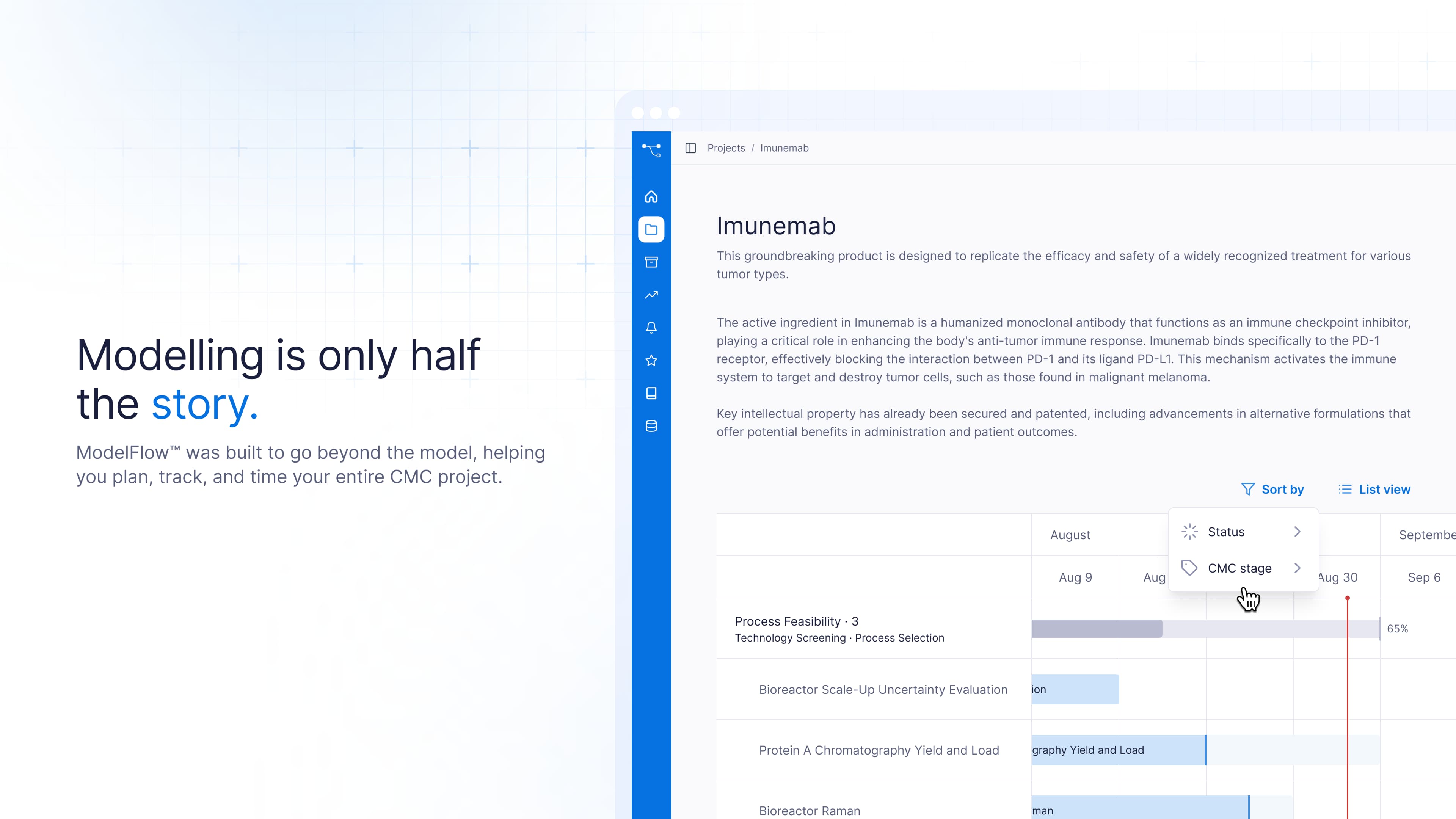
Across many CMC and MSAT programmes, scientific execution and project management remain disconnected. Process models, experimental results, and batch records often sit in specialised tools or local drives, while timelines, milestones, and status updates are managed elsewhere. Because these tools aren't connected, there is no continuous, live view of progress. This forces teams to manually bridge the gap to answer a basic question: 'Where does the project actually stand?'
Why manual project tracking creates bottlenecks
When project tracking sits apart from scientific execution, operational disconnects emerge that slow progress:
Time lost gathering status: Project leads spend valuable hours chasing updates across functions, combining timelines from one tool with execution data from another simply to assemble a reliable view of progress.
Context lost during handoffs: Transfers to new sites or CDMOs may include the final batch record but leave behind important scientific context, such as tested ranges, parameter excursions, unsuccessful runs, and the reasoning behind key decisions.
Downstream impacts missed: When technical decisions are not linked to project timelines and dependencies, an upstream change - such as an adjustment to a crystallisation parameter - can affect downstream drying times or dissolution profiles without teams having early visibility.
Effort repeated across molecules: Previous learnings often remain scattered across static files and folders, making it difficult for new project teams to find, evaluate, and build on earlier work.
Scientific opportunities identified too late: New scientific insights and model-based approaches often emerge during development, whether from a recent publication, a newly learned method, or progress made elsewhere in the organisation. If teams cannot quickly assess and incorporate these approaches into the active plan, the project may pass the relevant milestone before they can deliver meaningful value.
To remove these operational disconnects, CMC and MSAT teams need a unified approach that connects scientific data, technical execution, and project communication. That is what ModelFlow™ is built around.
Make ownership explicit
Every deliverable should have one accountable owner, even when several people contribute. Linking roles directly to active deliverables makes ownership gaps, stalled work, and emerging constraints visible before they affect the schedule.
Project leads can see what is progressing, what is blocked, and who is responsible for the next action without waiting for another status meeting.
Preserve scientific context through technology transfer
Formal transfer packages capture the final process and selected operating parameters, but they do not always preserve how those decisions were reached. Tested ranges, parameter excursions, unsuccessful routes, negative results, and modelling assumptions may remain in local files or with the people who performed the work.
When modelling and analysis take place in ModelFlow™, that context remains connected to the relevant deliverables. A receiving site or CDMO inherits not only the final process, but also the scientific reasoning and development history behind it. This helps receiving teams answer questions without having to reconstruct the original work.
Assess downstream effects before scale-up
Unit operations are interdependent. A change to a crystallisation parameter may affect filtration performance, drying time, or the properties of the final drug product.
By connecting scientific work with dependencies and ownership across unit operations, ModelFlow™ helps teams identify which activities and stakeholders could be affected by a change. This allows potential downstream consequences to be evaluated earlier, when teams still have time to respond.
Reuse knowledge and act on new scientific insights
Models, results, assumptions, and development decisions from previous programmes should remain available for future teams to build on. Keeping this knowledge connected to its original scientific and project context makes it easier to assess what can be reused for a new molecule or process.
The same approach helps teams respond to emerging science. When a relevant publication, modelling technique, or improved workflow becomes available, teams can evaluate it against the programme’s current stage, open decisions, and upcoming milestones. This makes it easier to introduce new approaches while they can still meaningfully influence development.
ModelFlow™: Run the project, not just the model
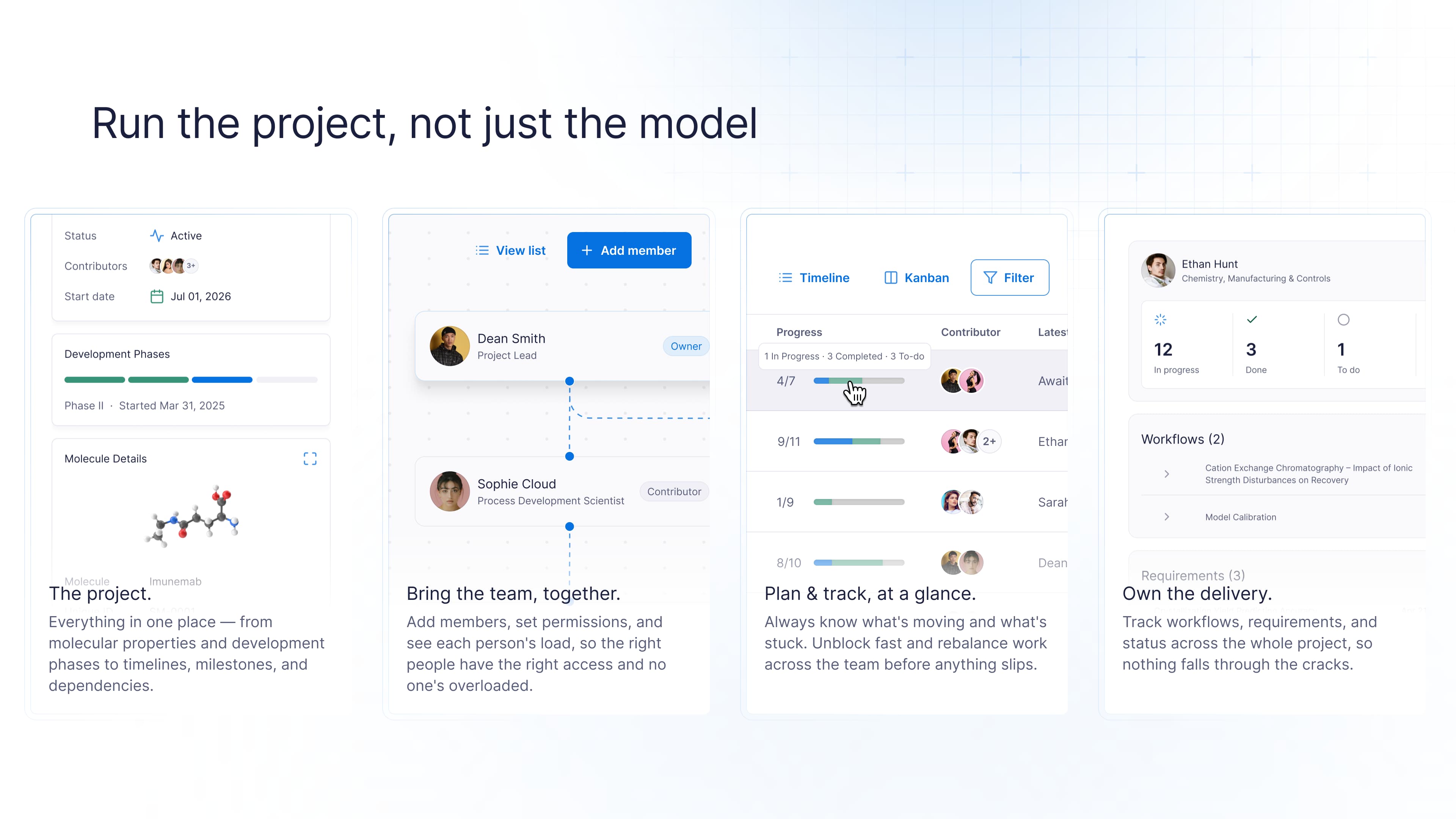
ModelFlow™ connects scientific execution and project management in one environment. Models and results remain linked to their deliverables, ownership is visible beside active work, and dependencies stay connected across development, scale-up, and technology transfer.
Instead of manually assembling updates, CMC and MSAT leaders gain a current view of programme health. Teams can preserve scientific reasoning, understand downstream dependencies, reuse previous knowledge, and introduce new approaches at the point when they can deliver the greatest value.
