Table Of Contents:
The problem: models that don’t scale
What is a workflow
From isolated exercises to operating capability
Why cross-functional alignment matters
How ModelFlow™ makes workflows real
Measurable business value
Conclusion: build the decision layer, not another model file
Models are essential. But alone they rarely change how development actually happens. Workflows are the missing layer that connects models, data and people - and turns technical insight into repeatable, auditable decisions.
The problem: models that don’t scale
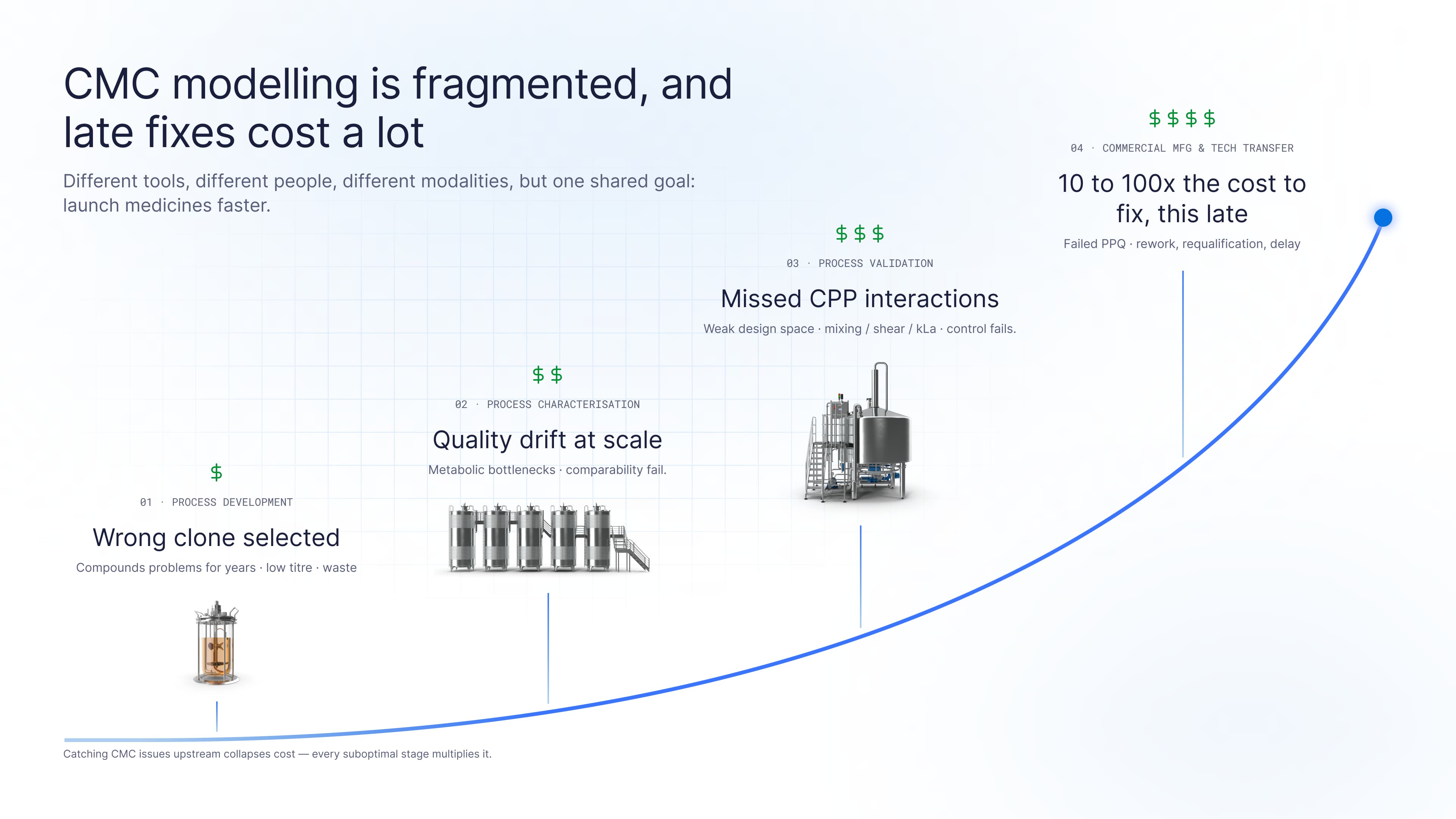
In biopharma process development, the industry isn’t short of models. What most teams lack is usable, connected decision-making - the systems that let a model inform a real-world choice. Too often a modelling effort ends as a file on a server, a slide deck, or a one-off report. Experimental data sits elsewhere in ELNs or LIMS, and the practical logic that links a process question to a decision is left implicit.
The result: iterative, resource-intensive work, slow technology transfer, fragile handovers, and endless rework. Organisations end up rebuilding the same logic from scratch because assumptions are buried in spreadsheets or tribal knowledge.
Top-tier biopharma companies are already moving the other way: they’re standardising on integrated workflows that shorten tech transfer, accelerate regulatory submissions, and scale pipeline throughput. If your modelling sits in a silo, you’re falling behind.
What is a workflow
A workflow is a structured, repeatable process for answering a scientific or engineering question. In biopharmaceutical process development and manufacturing, every workflow begins with a problem that needs to be solved—whether that’s selecting the next experiments, optimising a unit operation, understanding process variability, or supporting scale-up.
In ModelFlow™, the workflow connects the scientific question, the data requirements, the analysis steps, and the downstream decision into a single, managed system. It’s a repeatable, auditable path that begins with a process question and culminates in a supportable decision. Concretely, a workflow:
Defines the problem statement.
Designs the required experiments.
Executes the experiments and processes the resulting data.
Calibrates and simulates the model.
Analyses the output.
Leverages the results to make an informed decision.
That structure - linking question, data, analysis and decision - is what makes modelling operational.
From isolated exercises to operating capability
Most modelling today is a specialist exercise: a modeller solves a program’s problem, hands the output back, and moves on. The next team repeats the work because the assumptions, data transformations, and decision logic weren’t preserved as an operating capability.
A workflow changes that. It embeds the scientific method in software: data requirements are explicit up front; data processing is standardised; calibration and analysis steps are defined; and the entire package is stored, versioned and deployable. The result: a reproducible capability teams can reuse and adapt, not a one-off analysis that vanishes when the project ends.
Why cross-functional alignment matters
Biologics development is rarely limited by a single variable - it’s limited by friction between functions. Process scientists, modellers, digital teams and manufacturing stakeholders each have different needs:
Scientists need clear experimental instructions.
Modellers need consistent, model-ready data.
Digital teams need maintainable pipelines.
Program leads need confidence that the work reduces risk and compresses timelines.
A standalone model solves only one of these. A workflow aligns them all by making responsibilities, inputs and outputs explicit.
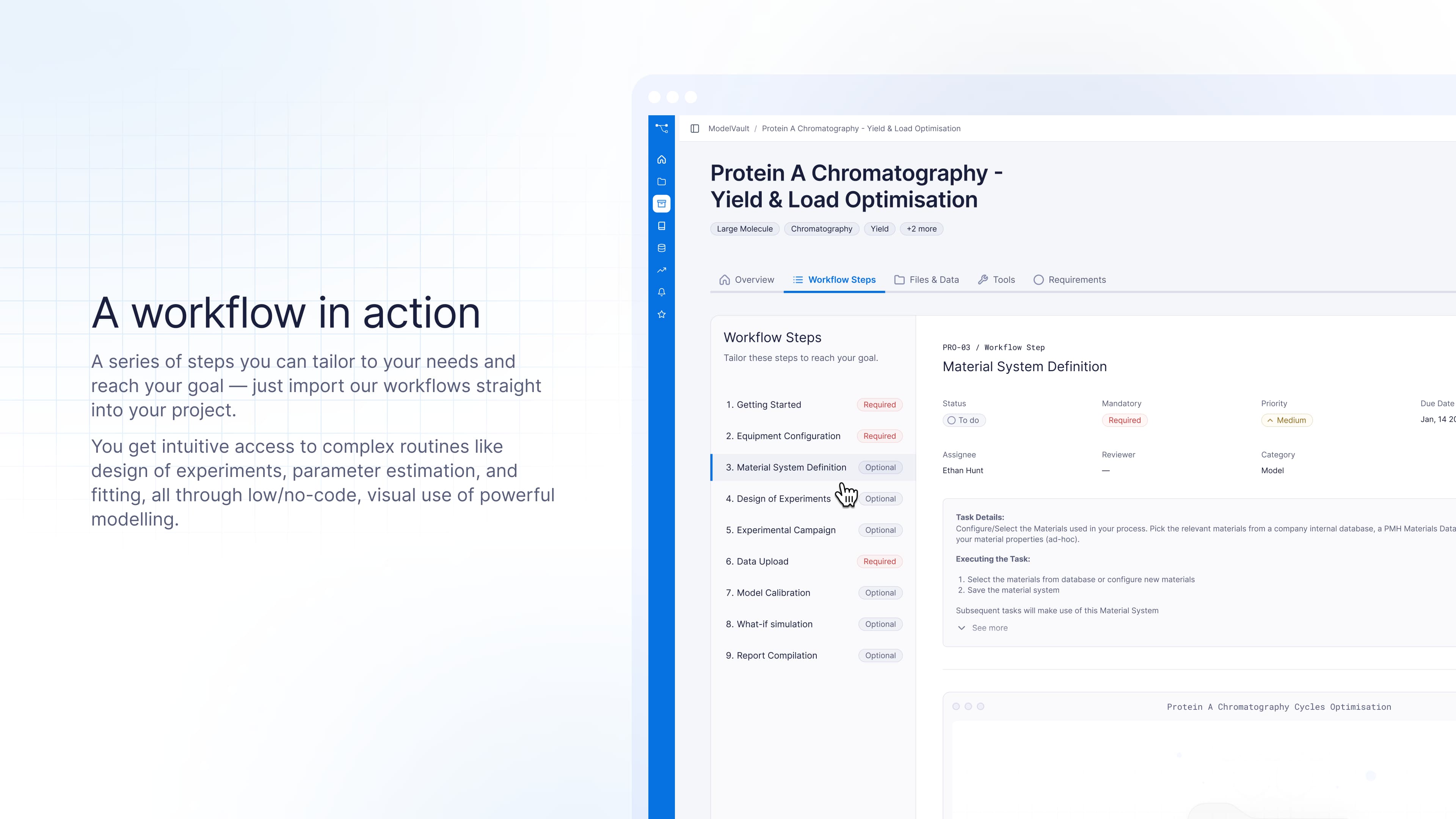
For example, optimising a Protein A chromatography step isn’t only about the chromatography model. It also requires defining the process question, prioritising experiments, ingesting resin and equipment data, transforming inconsistent lab outputs, calibrating the model, and running what-if trade-offs between recovery and utilisation. The workflow creates a disciplined route from question to decision.
How ModelFlow™ makes workflows real
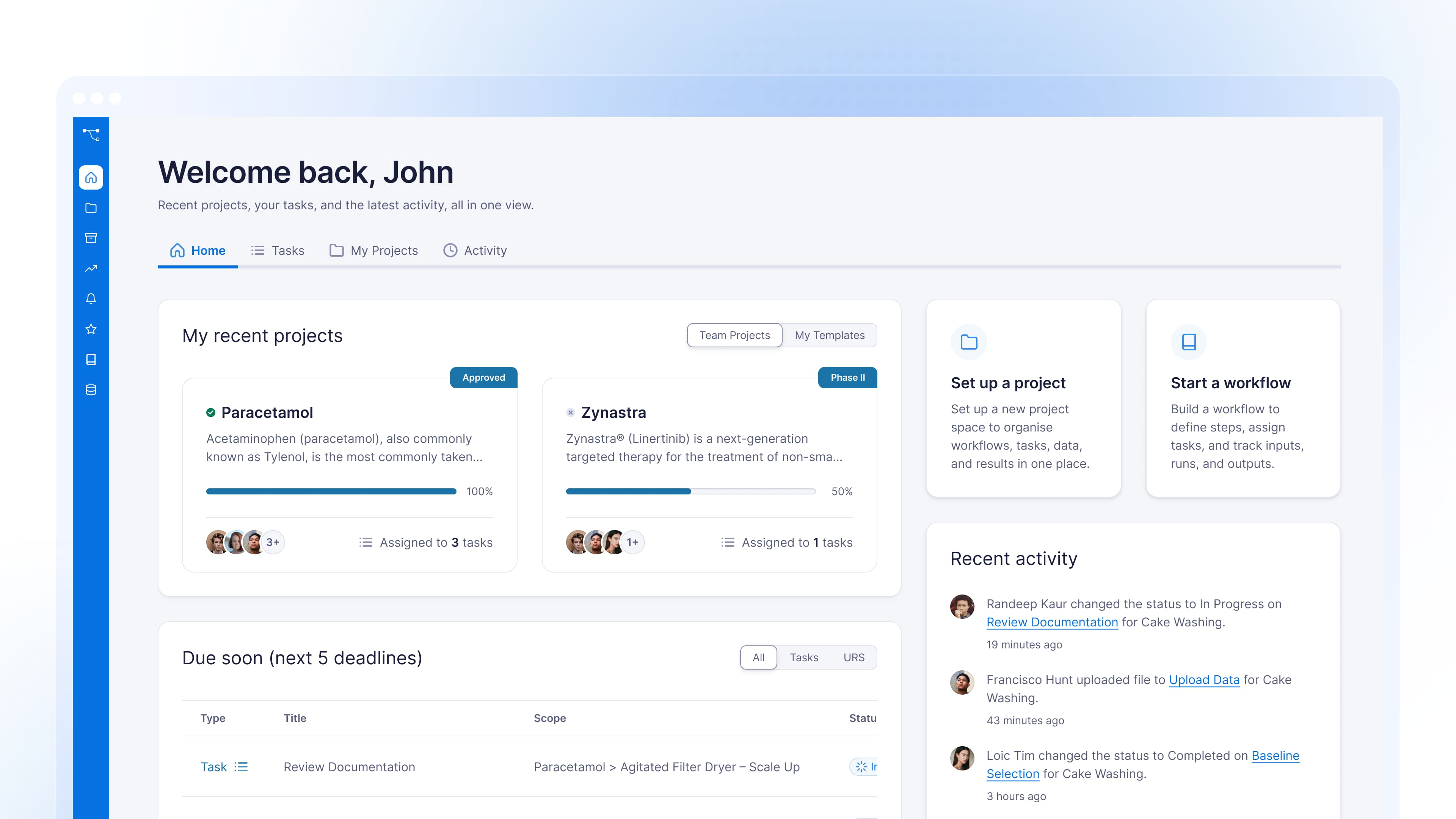
ModelFlow™ is the environment where models, data pipelines and teams meet, and where modelling is turned from a one-off exercise into repeatable, governed capability. The platform connects directly to ELNs, LIMS and equipment/material databases, translates messy experimental outputs into validated, model-ready inputs, and runs calibration and analysis inside a controlled workspace so results are auditable and reusable.
In practice ModelFlow provides the concrete pieces a workflow needs:
Guided experimental design. ModelFlow recommends the experiments that matter and embeds design-of-experiments tools so scarce material and lab time target high-value runs.
Automated ingestion & pipelines. Connectors pull equipment, process metadata and processing nodes standardise diverse schemas, validate inputs against model expectations, and produce clean datasets without manual data janitoring.
Managed project & task flow. Each workflow is a managed project with assigned tasks, timelines, documentation and modular steps (theory → experiment → processing → calibration → simulation → reporting), so decision logic stays with the work.
Fast, reproducible calibration & analysis. Parameter estimation, global sensitivity analysis and optimisation run inside the platform using pluggable solvers; the architecture is tuned for fast convergence so teams can iterate what-if studies and optimisations in minutes rather than hours.
Web apps. Scientists interact through intuitive web apps, modellers retain control of the code and logic using complex models without code.
System thinking & decision support. ModelFlow supports single-unit and multi-unit system models, exploration plots and scenario generators that reveal safe operating regions and prioritize the next experiment, helping avoid costly, unnecessary lab work.
Measurable business value
A workflow-first approach yields measurable benefits:
Faster tech transfer - standardised, repeatable logic shortens handover time.
Fewer experiments - better experimental design and reuse reduce unnecessary runs.
Less rework - explicit assumptions and versioned workflows prevent lost knowledge.
Better scale-up confidence - system models and connected workflows expose downstream bottlenecks early.
We’ve seen teams replace months of manual data wrangling with days of model-powered analysis by moving workflows into a managed platform. Those are the ROI levers that matter when you’re charged with getting medicines to patients faster.
Conclusion: build the decision layer, not another model file
The goal of process development investment should be clear: not to buy or build another model but to create a reliable decision-making layer that links data, models and teams. When one group solves a problem in that layer, the solution doesn’t disappear - it becomes a versioned, auditable, reusable asset that accelerates the next program.
Models are necessary. Workflows are what make models operational. If you want to move faster while maintaining scientific rigour, start by designing the workflow, then fit the models into it.
Ready to see ModelFlow in action?
